

The SEC’s Unequal-Enforcement Problem: Why LSU Defendants May Have a Counterclaim of Their Own
How the SEC’s rushed professionalism rule could create a selective-enforcement problem
The SEC’s new lawsuit against LSU presents the dispute as a matter of conference integrity. According to the SEC, LSU’s decision to roster former professional players threatens the distinction between college and professional athletics, creates competitive imbalance, and undermines the Conference’s institutional identity.
But that framing creates an obvious question of its own:
Is the SEC applying its new “professionalism” policy equally to all sixteen member schools?
That question may matter as much as the underlying eligibility dispute.
The SEC’s new federal lawsuit against LSU may create problems the Conference did not intend when it chose to take this dispute to court.
The SEC sued five defendants in the Northern District of Alabama: Louisiana State University; the LSU Board of Supervisors; LSU President Wade Rousse; Athletic Director Verge Ausberry; and Head Football Coach Lane Kiffin. The SEC alleges that LSU’s effort to roster former professional players violates the Conference’s First Amendment right of expressive association and seeks declaratory and injunctive relief under 42 U.S.C. § 1983.
Two of those defendants—LSU and its Board—have an obvious threshold defense. LSU and its governing Board are state entities, and Louisiana has not generally consented to being sued in federal court. The Eleventh Amendment therefore presents a substantial sovereign-immunity problem for the SEC’s direct claims against them. Section 1983 creates another problem because a State and its arms are not “persons” within the meaning of § 1983. LSU and the Board should seek dismissal on those grounds unless the SEC can identify an effective waiver of sovereign immunity in the Conference’s governing or membership agreements.
But Rousse, Ausberry, and Kiffin are different. The SEC sued each only in his official capacity and seeks prospective relief, plainly attempting to invoke the Ex parte Young exception to sovereign immunity. If those defendants remain in the case, they should not necessarily be content simply to defend the SEC’s First Amendment theory. The lawsuit may also provide a vehicle to force the SEC to answer a much more basic question:
Is the Conference applying its new professionalism rule equally to all sixteen member schools?
That question could become central to the case.
The SEC’s Rule Does Not Define “Contract”
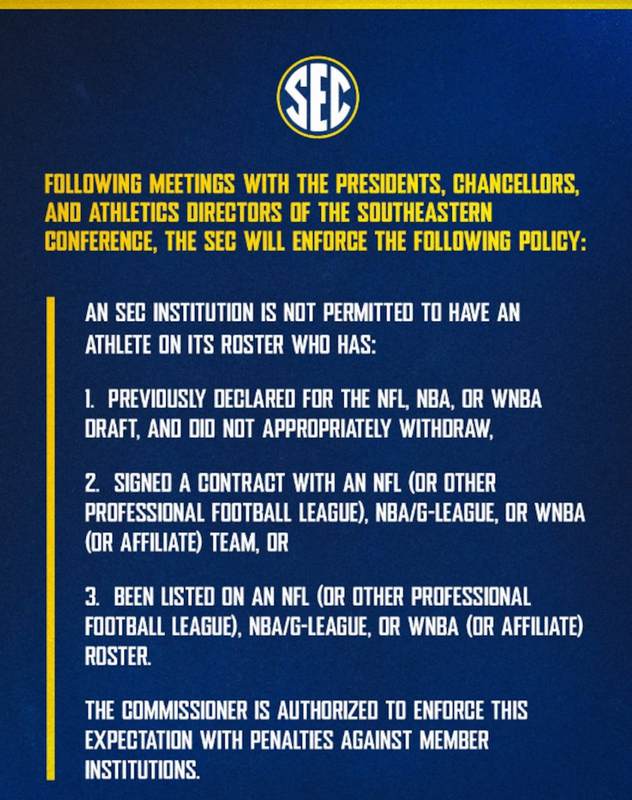
On August 25, the SEC announced its new “Professionalism Policy":
Rule number 2 says that a member institution may not roster an athlete who has:
“Signed a contract with an NFL (or other professional football league) … team.”
The SEC’s own federal complaint quotes that language.
But the policy does not define “contract.” It does not say “NFL Player Contract.” It does not say “Standard Player Contract.” It does not say “employment contract to compete in professional football.”
That distinction matters because players and prospective players can execute other agreements with NFL clubs before ever signing an NFL Player Contract.
The NFL collective bargaining agreement itself recognizes minicamp participation agreements and distinguishes those arrangements from an NFL Player Contract. It also contemplates compensation, travel, lodging, meal allowances, injury protection, and other benefits associated with participation in NFL club activities even where no NFL Player Contract exists. The well-publicized 2025 dispute involving Bengals rookie Shemar Stewart illustrates the point. Stewart’s participation in rookie minicamp was affected by a dispute over a required participation waiver before he had signed his actual rookie player contract.
That does not necessarily mean every rookie-minicamp waiver falls within the SEC’s rule.
It does mean that “contract with an NFL team” and “NFL Player Contract” are not necessarily the same thing.
If the SEC intended the latter, it could have said so.
It did not.
Other SEC Players Pursued NFL Opportunities and Came Back
That ambiguity becomes much more important because LSU is not the only SEC program dealing with players who pursued professional football before returning to college.
Cole Hutson attended rookie minicamps with both the Dallas Cowboys and Cleveland Browns before returning to Texas.
Sterling Webb participated in Buffalo’s rookie minicamp before returning to Missouri. Webb played for Missouri against UAPB on September 3, 2026.
Braxton Fely participated in Cleveland’s rookie minicamp before returning to Oklahoma following judicial eligibility relief.
Alex Afari Jr. participated in the Green Bay’s rookie minicamp, obtained a TRO restoring his eligibility, and is back with Kentucky for 2026.
Ethan Sanchez attended a 49ers rookie camp, obtained a TRO, and is set to play for South Carolina this year.
Others have followed similar paths. The significant factual question is therefore not simply whether those athletes “went to minicamp.”
It is:
What did they sign in order to participate?
If an athlete had to execute a written participation agreement, waiver, release, compensation agreement, or other enforceable instrument with an NFL club, that document becomes highly relevant to the SEC’s own choice of words.
And if the SEC has concluded that such an agreement does not constitute a “contract with an NFL team,” it should be able to identify:
when that interpretation was adopted;
where it was written down;
whether every SEC institution was given the same interpretation; and
whether it has been applied consistently.
The Real Issue Is Unequal Treatment of Member Schools
The strongest challenge is not:
Every NFL minicamp waiver necessarily makes an athlete ineligible.
That overstates the case.
The stronger argument is:
The SEC cannot adopt a facially uniform rule, leave an important operative term undefined, and then supply an unwritten limiting definition selectively when deciding which member institution to punish.
The Conference has threatened extraordinarily serious consequences if LSU plays the former professional players at issue. At the same time, other SEC institutions have rostered or sought to roster athletes who pursued professional employment and participated in NFL activities without provoking comparable federal litigation against their presidents, athletic directors, and coaches.
But if materially similarly situated athletes are being treated differently depending upon which SEC school they attend, the dispute stops being merely about the wisdom of the Conference’s eligibility rule. It becomes a question of arbitrary and selective enforcement.
Alabama Law May Matter More Than the First Amendment
The SEC is organized under Alabama law and headquartered in Birmingham. Alabama courts generally defer to the internal governance of voluntary athletic associations. But that deference is not absolute. Alabama precedent recognizes judicial intervention where an association acts arbitrarily, outside its jurisdiction, collusively, fraudulently, or contrary to public policy. And Alabama athletic-association cases have specifically considered whether rules were uniformly applied to similarly situated participants. That makes comparator evidence critical.
A court could reasonably ask:
What does the SEC mean by “contract”?
Does “contract” mean “NFL Player Contract”?
If so, where does the policy say that?
When did the SEC adopt that interpretation?
What agreements did Hutson, Webb, Fely, and other returning players sign with NFL clubs?
Did the SEC investigate those agreements?
What did the SEC tell its member institutions?
Were substantially similar cases treated substantially the same?
The answer to those questions could determine whether the Conference is merely exercising legitimate eligibility discretion or enforcing an unwritten standard selectively.
The SEC’s Own Complaint Makes the Comparison More Important
The SEC has made uniformity a central theme of its federal lawsuit. Its complaint says the Conference has survived for nearly a century because its members adhere to a common set of rules. It alleges that the professionalism rules preserve competitive fairness and ensure that SEC schools compete under the same foundational standards. It further alleges that LSU has created a competitive imbalance because other institutions have followed those rules.
Those allegations invite scrutiny of how the rules are actually being applied.
If uniform treatment is essential to the SEC’s claimed injury, then evidence that the Conference applies materially different standards to materially similarly situated schools could undercut not only a counterclaim but also the SEC’s own request for preliminary injunctive relief.
There Could Also Be a Federal Equal Protection Theory
The federal theory is more complicated. A private association ordinarily is not subject to the Equal Protection Clause. But the SEC has pleaded unusually interesting facts concerning its own governance.
According to its complaint, fifteen of the SEC’s sixteen member institutions are public universities. The Conference further alleges that those institutions’ presidents and chancellors exercise “plenary power over all Conference affairs” and that the member institutions collectively control Conference policy. Those allegations potentially implicate the Supreme Court’s Brentwood Academy state-action doctrine, under which sufficiently pervasive entwinement between public institutions and an athletic association can subject the association to constitutional limitations.
The SEC would have a serious response under NCAA v. Tarkanian, which rejected state action in the context of the NCAA. The SEC, however, is a much smaller association and—by its own allegations—is overwhelmingly composed of public institutions whose presidents actually govern Conference affairs. If the SEC is ultimately treated as a state actor, intentionally applying materially different standards to similarly situated school officials could support an Equal Protection claim.
Lane Kiffin would have the most obvious individual interest if the Conference threatens to suspend him personally from coaching.
The Undefined Standard Also Raises a Due Process Question
The undefined word “contract” is not automatically unconstitutional. Civil regulatory rules need not define every term with mathematical precision. But ambiguity becomes much more consequential when it is combined with:
extraordinary sanctions;
no published limiting definition;
inconsistent interpretations;
and different treatment of similarly situated institutions.
If “contract” actually means “NFL Player Contract,” that distinction should have been in the rules released by the Southeastern Conference. If it means every enforceable agreement with an NFL club, that has very different consequences. A rule that becomes clear only after the Conference identifies the institution it intends to punish presents a much different problem than an imperfectly worded but uniformly understood eligibility rule.
Expedited Discovery Could Answer the Question Quickly
This dispute is particularly well suited for expedited discovery because the critical evidence should largely consist of documents and communications rather than subjective speculation. The LSU defendants could seek immediate discovery concerning:
all SEC definitions and interpretations of “contract,” “NFL Player Contract,” “professional athlete,” “minicamp,” and “training camp”;
communications concerning Cole Hutson, Sterling Webb, Braxton Fely, and other returning athletes;
communications between the SEC and Texas, Missouri, Oklahoma, Kentucky, Ole Miss, Mississippi State, LSU, and other member institutions;
all eligibility determinations, exceptions, interpretations, enforcement decisions, and non-enforcement decisions under the August 25 policy;
the participation agreements and related documents executed by returning athletes with NFL clubs; and
communications concerning the SEC’s decision to pursue LSU and its officials.
The SEC May Have Opened a Door It Did Not Intend to Open
The SEC went to federal court asserting that common rules, institutional integrity, competitive fairness, and uniform compliance are important enough to implicate the First Amendment. That decision may come with consequences.
Once the Conference asks a federal judge to protect the integrity of its rules, the defendants are entitled to ask how those rules have actually been interpreted and enforced. If the SEC can demonstrate a definite standard applied consistently to every school, that substantially strengthens its position.
If it cannot, LSU’s representatives may have more than defenses to the SEC’s lawsuit.
They may have claims of their own.
A Proposed Path Forward
That leaves the practical question: what would a legal challenge based on unequal treatment actually look like? Below is a proposed complaint seeking declaratory and injunctive relief against the SEC. The theory is deliberately narrow. It does not ask a court to decide that every NFL minicamp participant is a “professional athlete,” or that every minicamp agreement necessarily violates the SEC’s policy. Instead, it asks the SEC to do what its own lawsuit says is essential to conference competition: apply the same rule, using the same definitions and standards, to similarly situated member schools. If the SEC intends to punish LSU and its officials under an unwritten distinction between an “NFL Player Contract” and other contracts with NFL teams, while approving comparable players at other SEC institutions, that distinction—and the disparate treatment resulting from it—should be subject to judicial scrutiny.
DISCLAIMER: THIS IS A PROPOSED COUNTERCLAIM. THE AUTHOR DOES NOT REPRESENT ANY OF THE NAMES PARTIES IN THIS SUIT.